
Publish faster without sacrificing truth. Understanding AI hallucination rates in 2026 dictates your agency’s ability to scale SEO effectively. Even a tiny 2 to 5 percent error rate corrupts thousands of programmatic pages.
Wrong facts and broken schema destroy client trust instantly. Manual review slows your production velocity to a crawl. Missed errors erode search rankings and damage brand credibility.
We will quantify these error rates by task and explain reliable evaluation methods. You will see the exact automation stack that catches mistakes before content goes live. This guide relies on current public benchmarks and proven quality workflows.
Understanding Factuality And Model Reliability
What Error Rates Actually Measure
A hallucination happens when an AI generates false or unverified information. You must distinguish between basic factuality and proper attribution. Factuality means the claim is objectively true in the real world.
Proper attribution means the model cites a specific source correctly. Different generation setups produce completely different error profiles.
- Closed-book QA: The model answers from internal memory without external search.
- RAG: The system retrieves external documents to ground its answers.
- Citation-required tasks: The output must link directly to verified sources.
The Cost Of Manual Fact-Checking
Agencies lose thousands of billable hours to manual editing. Reviewing long-form content for factual accuracy drains your profit margins. Human editors miss subtle technical errors during high-volume production sprints.
Relying on human review prevents true scale. You cannot achieve Content Dominance if every article requires an hour of manual fact-checking. You need systems that verify truth automatically.
How Decoding And Verification Work
Modern systems use advanced techniques to improve model reliability at scale. Self-consistency decoding forces the model to generate multiple answers and pick the most common one. This reduces random factual errors dramatically.
Confidence calibration helps the system know when it lacks the right answer. Verifier models act as a second layer of defense. They review the initial output and flag unsupported claims.
The 2026 Benchmark Data And Mitigation Stack
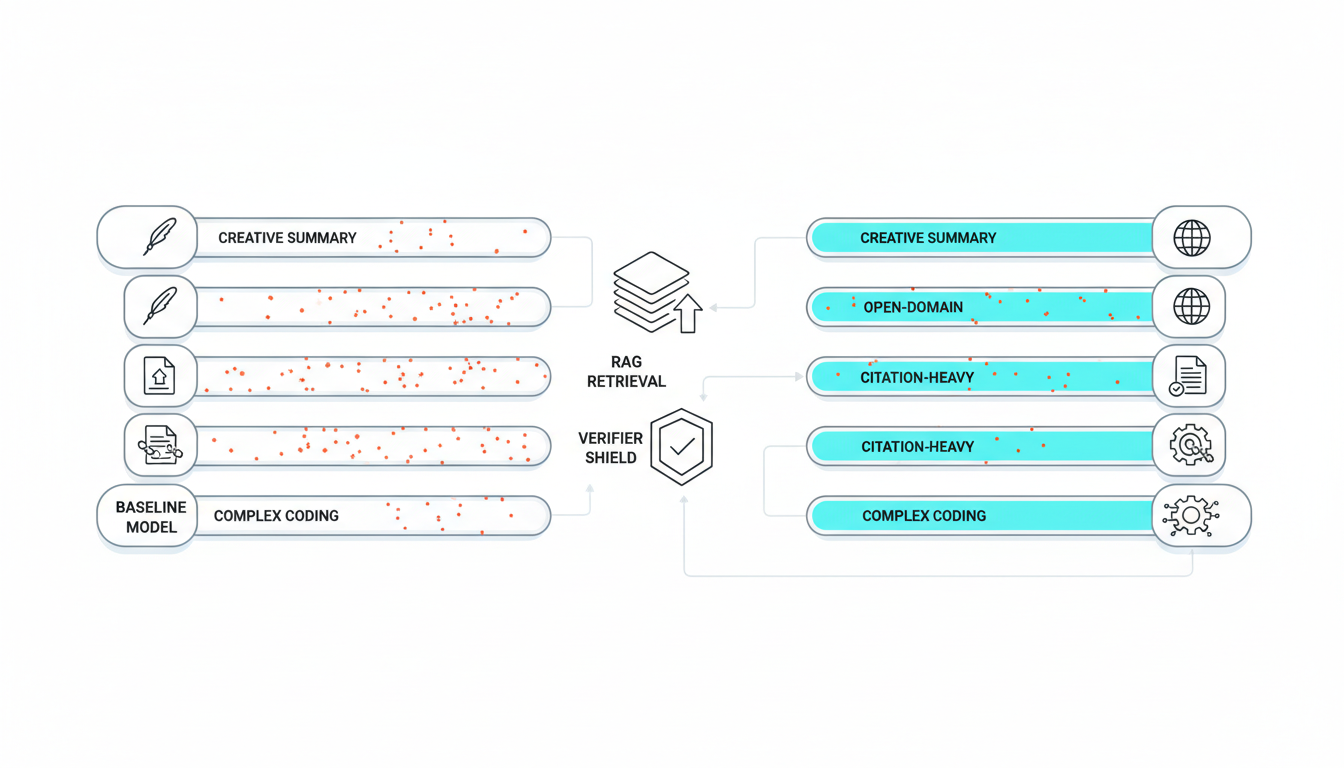
Estimated 2026 Error Rates By Task
Different tasks carry completely different risk levels. You cannot treat a creative summary the same as a medical definition. The underlying complexity dictates the expected failure rate.
- Creative summarization: 1 to 2 percent error rate.
- Open-domain questions: 3 to 5 percent error rate.
- Citation-heavy content: 4 to 7 percent error rate.
- Complex coding tasks: 5 to 8 percent error rate.
Recent data on AI hallucination rates in 2026 shows that controls matter more than the base model. Adding RAG and proper verifiers cuts these baseline errors in half.
Building Your Policy Guidelines
You need strict policies to manage truthfulness across thousands of pages. Clear sourcing rules prevent models from using low-quality reference material.
- Set strict citation thresholds for technical claims.
- Define clear rejection criteria for unsupported statements.
- Require automated citation checking before publication.
Practical Controls For Publishing Pipelines
Agencies need practical ways to enforce these rules. A pre-publish checklist guarantees every article meets your standards. You can learn how automation controls hallucinations across your entire portfolio.
UberPress uses a Research Pack to extract brand facts accurately. Money Page Detection identifies high-value targets for safe internal linking. The Triple Verification system enforces grounding and checks citations automatically.
This entire process happens instantly. The system completes these checks before the Auto-Publisher / WordPress Automation sends content live.
Implementation And SOPs For SEO Agencies
Calculating Edit Time Savings
Manual editing drains your agency margins quickly. An interactive calculator helps estimate your exact savings. You input your monthly page volume and baseline error rate.
Watch this video about AI hallucination rates in 2026:
The tool outputs your avoided costs and hours saved. This data helps you justify the investment in automated verification systems.
Role-Based Standard Operating Procedures
Every team member needs a specific role in managing guardrails. Clear responsibilities prevent quality control failures.
- SEO Lead: Designs the prompt engineering strategy and sets quality thresholds.
- Editor: Reviews flagged claims and updates the core knowledge base.
- Publisher: Manages the Automate your WordPress publishing flow settings and API connections.
Post-Publish Monitoring Plan
Quality control continues after the article goes live. You must run post-publish audits to catch any lingering issues. Check your link equity distribution regularly.
Set up regression alerts to spot broken schema or dropped rankings. You can Explore Features that handle these monitoring tasks automatically. You can also Discover best practices for long-term quality maintenance.
Managing Schema Accuracy At Scale
Programmatic SEO relies heavily on perfectly structured data. A single hallucinated value in your schema breaks the entire page markup. Search engines penalize sites with invalid structured data.
Automated verification tools validate schema against actual page content. This prevents the AI from inventing review scores or product prices.
Scaling Truth With Content Dominance
Managing factual accuracy at scale requires the right systems. The 2026 rates vary heavily by task and setup.
- Controls matter far more than the underlying AI model.
- Retrieval and verifiers reduce errors significantly.
- Building checks inside your CMS eliminates manual rework.
- Automated internal linking reinforces topical authority safely.
You now have the measurement playbook to scale truth at speed. Explore how end-to-end automation enforces factual controls in your pipeline. Experience 7-Minute Execution from keyword to published post. Start SEO Domination today.
Frequently Asked Questions
What causes language models to invent facts?
Models predict the next logical word based on training data. They lack true understanding of the real world. When training data is sparse, the model guesses and creates false claims.
How do retrieval systems reduce errors?
These systems force the AI to read specific documents before answering. The model extracts facts from the provided text instead of guessing. This grounds the output in verified reality.
Which task has the highest error risk?
Citation-heavy content and complex coding tasks carry the highest risk. These tasks require precise syntax and exact factual matching. Creative writing tasks generally show much lower error frequencies.
Can automated pipelines catch factual mistakes?
Yes. Multi-layer verification systems scan text for unsupported claims automatically. They cross-reference statements against approved knowledge bases before publishing. This prevents false information from reaching your live website.
